
You’ve all seen it. Walking down the sidewalk, sitting inside a skyscraper, looking out the window- maybe you’ve even heard it too. A bird striking a window.
It’s a very sad but real issue. Glass presents a dangerous environment for birds. According to the U.S. Fish and Wildlife Service, building-glass collisions are the second leading cause of human-caused deaths for these animals.
For some Keweenaw-based entrepreneurs, this problem presented an opportunity.
Averta Deterrents is a brand of Keweenaw Ecological Innovations (KEI). This company is working to develop easily adaptable solutions to various ecological challenges. Averta was born out of research conducted by co-Founders Jared Wolfe, KEI’s Chief Ecological Officer and MTU Associate Professor; and Shane Oberloier, Chief Engineering Officer at KEI and Assistant Teaching Professor of Electrical and Computer Engineering at MTU.
Wolfe was looking for someone to develop devices needed for his conservation work, and Oberloier, along with his students, provided much-needed engineering expertise. Together, they began testing their audible bird-deterrent technology. After yielding successful test results in Chicago, they realized this product could be taken a step further, towards commercialization.
“We wanted a way to deter birds without a bunch of expense, and obviously wanted it to be effective.”
Sky Shepherd
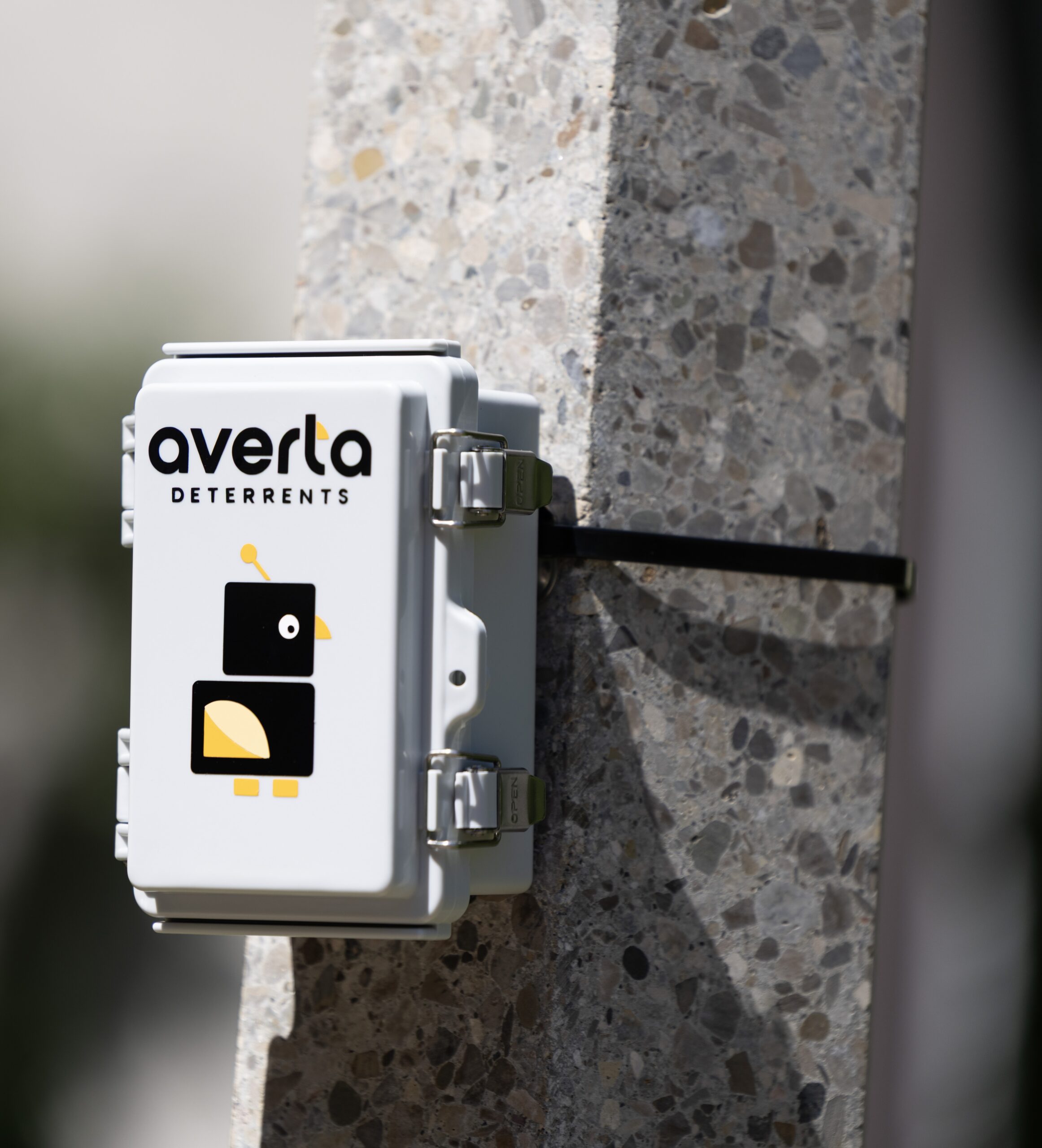
The concept is relatively simple: audible devices are installed on buildings where migratory bird strikes are common. The sound played is intended to steer the birds away from the glass surface, preventing them from colliding with the obstacle, and keeping them in safer airspace.
Oberloier shares, “One of the original names we wanted to go with was Sky Shepherd. That’s the idea: it’s shepherding birds to a safe spot.”
The devices are designed to be tailored to any specific building needs. Users can adjust the volume level, schedule when sound is played, or turn the system on or off all through an app. For example, a facilities manager could turn the system off for a special event, schedule it to run during peak migration periods, or set a daytime timer to avoid disturbing residential buildings nearby. “The real target is any urban area that has a lot of glass,” Oberloier notes.
In addition to the device, Oberloier also developed a tool called the Deployment Studio. This program allows prospective clients to visualize exactly where the deterrents would be placed and how varying volume levels affect overall coverage.
“The people that need Averta deterrents already know they need them because people are telling them there are dead birds around. This is something that’s really quick and easy to install that can solve those problems compared to a really lengthy window-film installation or something.”
This technology allows organizations to make their buildings and structures safer for migratory birds without having to alter preexisting architecture.
Becoming a Business with MTEC SmartZone
Shane’s involvement with MTEC SmartZone began long before Averta. He participated in MTEC’s SmartStart program nearly a decade ago. At the time, Shane had plenty of technical skill and ideas, but much less experience turning those ideas into a business.
“At that point, [before SmartStart] I was really, really ignorant of business. I could imagine what it would look like, but I didn’t know how to turn an idea into something. The most important thing you get out of that, and now, every time I do any sort of business training, is that you just have to talk to people and make sure you’re working on a problem that people care about.”
More recently, MTEC helped Averta secure a Business Accelerator Fund (BAF) grant to promote and spread awareness of the technology. Oberloier and his cofounder Jared Wolfe also represented the company at the 2026 PitchMI Semifinals in Marquette.
A Safer Migration
Today, Averta is planning to launch in early 2027.
Oberloier’s long-term vision is more than just installing devices. His dream is to have these deterrents spread across a city. “You’d have this entire network that helps cue birds where it’s safe and where it’s dangerous. It makes it easier for birds to hop from safe green space to safe green space. That’s the pie-in-the-sky type of project,” he shares.
Sometimes, business support comes in the form of programming. Other times, it comes in the shape of business funding, or opportunities to share an innovation. For entrepreneurs like Oberloier and his team, these resources mean that an idea doesn’t just have to stay an idea. It can become an innovative solution that protects the environment and an entire species.
To learn more about Averta Deterrents, visit their website here.
About MTEC SmartZone
MTEC SmartZone is a 501(c)(3) non-profit dedicated to accelerating high-tech business growth in the Western Upper Peninsula. Established in 2003, MTEC is one of 20 statewide SmartZones supported by the Michigan Economic Development Corporation (MEDC). Through mentorship, direct grants, specialized programming, technical support, and other services, MTEC client companies have contributed over 1,110 jobs, $91.8 million in sales and revenue. MTEC has helped these companies realize over $594 million in follow-on funding. For more information, visit our website at mtecsz.com, follow us on LinkedIn and Facebook, or email us at mtec@mtecsz.com.
About the MEDC
The Michigan Economic Development Corporation, in collaboration with more than 100 economic development partners, markets Michigan as the place to do business, assists businesses in their growth strategies, and fosters the growth of vibrant communities across the state. MEDC’s Entrepreneurship & Innovation initiative establishes Michigan as the place to create and grow a business by providing high-tech start-up companies with access to a variety of critical resources, such as funding and expert counsel, from ideation to maturation. For more on MEDC Entrepreneurship & Innovation, visit michiganbusiness.org/entrepreneurship.